MOLDOVA
- Dates
- 20.11—17.12.2026
- Opening
- 20 November 2026, 18:30
- Address
- Markgrafenstr. 68
- Entry
- Free
Moldova is returning to Europe politically. This exhibition is a reminder that culturally it has always been part of it.
Moldova is a young European country preparing to join the European Union. Moldovan art took shape where several traditions meet: European modernism, the local artistic culture and the Soviet experience. Now that the country is choosing its European future with growing certainty, it is especially interesting to see what visual language has formed in this complex historical space.
The three artists shown in Berlin — Mihai Țăruș, Victor Guțu and Tudor Zbârnea — are key figures of contemporary Moldovan painting. They are completely different, yet something unites them, and the exhibition brings it to light.
For Mihai Țăruș, geometry is a way of freeing painting from the dictate of the image. His compositions are built on relations of form, colour and space, but the geometric order never hardens into a rigid system. It stays open and mobile, allowing for chance and for the artist’s own freedom.
Victor Guțu creates a whole world populated by people, animals and fantastic creatures. His free painting, with its traces of automatism, produces images that seem to appear by themselves. In this world the human has no privileged place: he exists on equal terms with other living beings, recalling a lost paradise before humans and nature were separated.
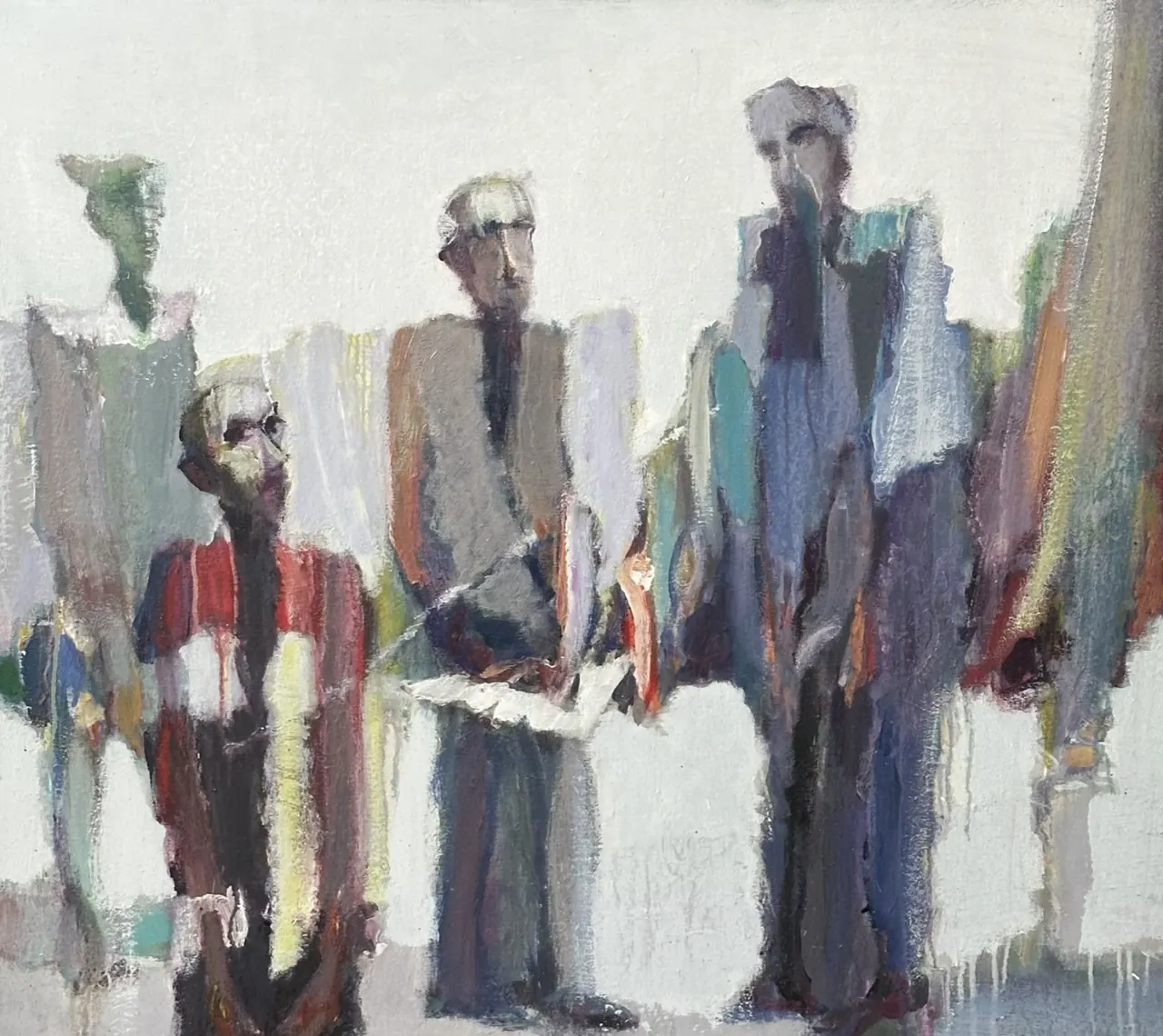
Tudor Zbârnea explores another border — between the appearance and the disappearance of an image. His figures surface through layers of paint, take shape and dissolve again. His multi-figure compositions are especially striking: the characters stand side by side but never interact. There is no plot, no event, no dialogue. Silence becomes the content of the picture, and painting becomes the story of how an image is made and gradually disappears.
These are three different answers to the question of what painting can be today. One artist frees form, another creates his own universe, the third turns the emergence of the image itself into the content of art. All three work on the border between abstraction and figuration, refusing to accept that border as final.
The exhibition does not claim to tell the whole story of Moldovan art. But it shows what matters most: a small country, long on the periphery of the European art world’s attention, has an independent and mature culture of painting.
Marat Gelman
Tudor Zbârnea
The painting of disappearance
Tudor Zbârnea’s painting lives in the space between the appearance and the disappearance of an image. He creates a figure, gives it recognisable features, and then seems to doubt that it needs to exist. He covers it with new layers of paint, blurs the contours, breaks the form — but never destroys it completely. The image becomes part of the story of its own making.
In most of his compositions the figures stand in a row, like characters in ancient murals. But unlike traditional multi-figure painting there is no plot, no action, no gesture connecting them. Instead of a narrative there is silence — not a pause before an event, but the absence of an event as such. The figures exist at the same time, but not together.
Zbârnea uses dense impasto, translucent layers, scratching, rubbing and vertical drips of paint. The surface recalls an old wall with traces of earlier images, or keeps the raw energy of a gesture. His colour is complex and restrained — silvery and bluish greys, earthy ochres, muted greens — with sudden flashes of red, yellow and turquoise.
Perhaps this is the central paradox of his art: the artist destroys the image in order to preserve the story of its existence. The finished painting is not the final version of an image but the sum of all its transformations.
Mihai Țăruș
Geometry without dictate
Abstraction no longer has to be a manifesto. Over the past century it has travelled from revolutionary discovery to one of art’s natural languages, a space for individual experience. This is what makes Mihai Țăruș so interesting.
He works with the simplest geometric forms — rectangles, stripes, intersecting planes — yet his paintings are remarkably free of geometric rigour. Geometry seems to take on human qualities: it becomes soft, mobile, at times uncertain. The relations between forms feel more like a free conversation than a strictly organised system.
Țăruș undoes geometric clarity with texture: the brushstroke is visible, the contours slightly blurred, the surface uneven. Form is not so much constructed as it emerges in the act of painting. Geometry lives in a world of ideal relations; painting lives in a world of material events. Behind the apparent freedom there is a precise sense of balance: the artist knows how far order can be broken before it disappears.
Țăruș was a student of Vladimir Sterligov, who in turn studied with Kazimir Malevich. Malevich freed painting from the world of objects. Sterligov sought freedom from the flat, rectilinear organisation of space. Țăruș frees geometry itself from its categorical nature. This is how a living tradition develops: not by repeating the teacher’s discoveries, but by gradually freeing itself from the limits those discoveries inevitably create.
Victor Guțu
The paradise of Victor Guțu
At first Victor Guțu’s work looks almost abstract: a mass of patches of colour, lines, brushstrokes and crossings. The eye cannot find the main thing or a familiar structure at once. Then images begin to rise out of the painterly chaos — a human face, an animal, a tree, a bird, a flower. The longer you look, the more you find, as if the picture were inhabited by creatures in no hurry to show themselves.
The world here is not depicted but comes into being — twice: first as the artist works, then in the eyes of the viewer. A human figure turns into a plant, a plant recalls an animal, a chance stain takes on the features of a face. The borders between beings are mobile and their transformations natural.
Clearly the artist paints a paradise. Not the paradise of religious painting with its fixed iconography, but paradise as a state of the world before the Fall, before humans and nature were divided. Here the human does not set himself against the rest of creation; he is one of God’s creatures, living alongside the others as an equal. Guțu does not even separate the animate from the inanimate. Everything has a life of its own.
There are elements of automatism in this process: the hand slips free of conscious control and chance becomes a full participant. But automatism is not a programme for Guțu; it is a way of finding images that cannot be invented in advance. Painting does not serve the image — the image is born from painting. His work gives back an experience civilisation has long made inaccessible: a sense of unity with a world in which every living thing exists without having to prove its superiority.